Timbre - Perceiving the Frequencies Within a Sound
Actually, the only sound in nature with just one frequency is the sine wave. This means that its pitch directly matches its frequency.
On the flip side, most natural sounds contain many different frequencies. These frequencies often have a special relationship called harmonics, which help determine the sound's pitch. These sounds have a mix of frequencies, giving them their own unique sound quality or timbre. Spectrograms help us see all these frequencies visually. They're super useful for understanding how sounds are made up of different pitches.
Oscilloscope and Spectrogam of Sine Wave
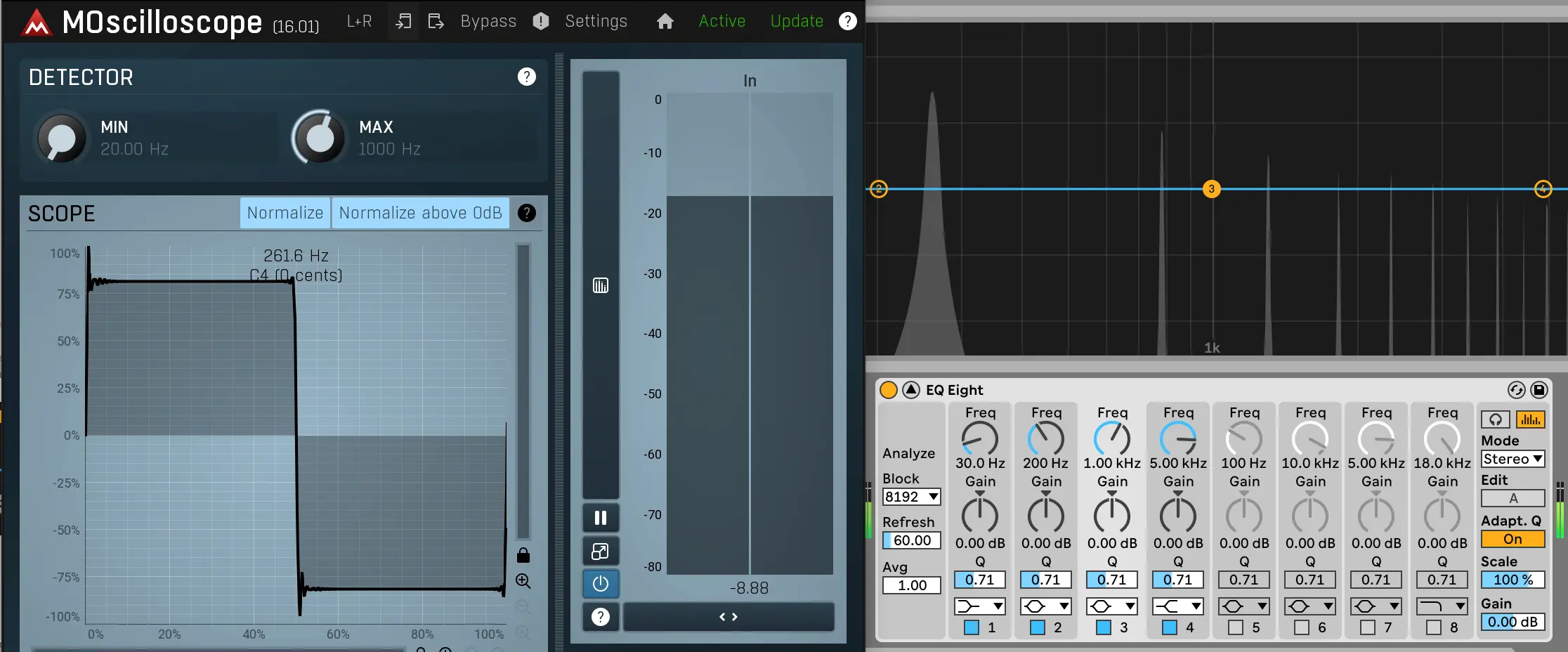
Here we have both an oscilloscope display and a spectrogram illustrating a sine wave.
Oscilloscope View (left):
- Time is depicted along the horizontal axis.
- The vertical axis denotes the amplitude of air pressure.
Spectrogram View (right):
- Frequency is represented along the horizontal axis.
- Magnitude of frequency is displayed along the vertical axis.
Observe the singular frequency displayed on the graph, indicating the presence of only one frequency within this sound.
A Square Wave: A More Complex Waveform
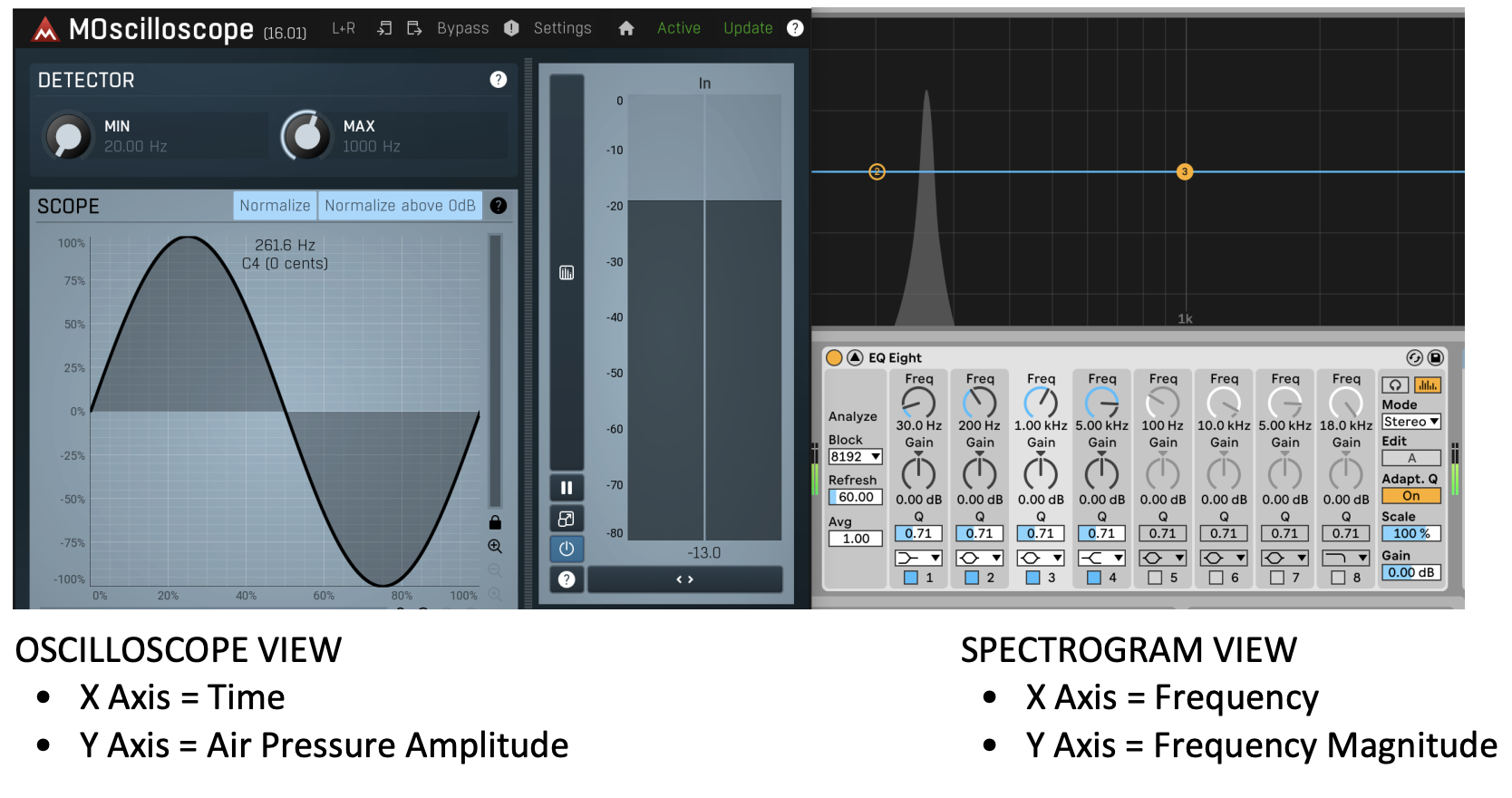
The image below depicts a square wave, characterized by a more intricate timbre. On the left, you can observe the waveform displayed on the oscilloscope, while the corresponding spectrogram is presented on the right. It's apparent that there isn't a straightforward method to ascertain the pitch. However, in this instance, we can identify the lowest frequency on the spectrogram (which coincidentally is the most pronounced) and conclude that it represents the fundamental frequency of the sound, thereby correlating with its pitch.