Comparison Between Video and Audio
Analogy for Sample Rate: Video Rate Franes
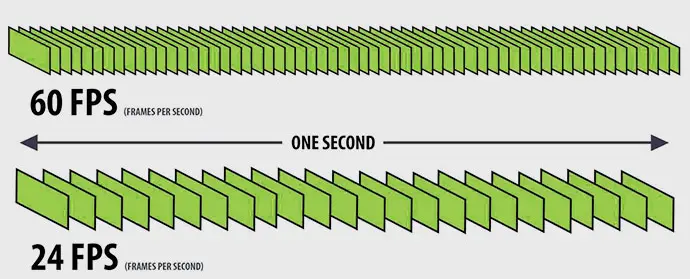
Think of the sample rate in audio recording as similar to the frame rate in videos. When you watch a video, what you're seeing is a series of still images (frames) played rapidly in succession. The frame rate, which is the number of frames displayed per second, determines how smooth and lifelike the motion appears. In audio, the sample rate works in a comparable way but at much higher frequencies. Audio operates at extremely high sample rates, capturing thousands of samples per second to ensure a smooth and continuous sound. This high sampling rate is necessary to accurately capture the full range of audible frequencies, especially the highest frequencies, to maintain sound fidelity and detail.
Analogy for Bit Depth: Image Resolution
Imagine taking a picture with a camera. If you take a picture with low resolution, the image will have fewer pixels, and it might look blurry or pixelated when enlarged. You’ll miss out on finer details like textures and subtle color variations.
Similarly, in audio, if you use a low bit depth, the sound will lack detail and can introduce noise or distortion. Higher bit depth captures more precise loudness information within the audio signal, much like higher resolution captures more details in an image. This increased detail in the loudness levels provides clearer, more accurate sound, enhancing the overall audio quality.

Conclusion
Just as higher frame rates in video provide smoother motion by capturing more frames per second, higher sample rates in audio capture more moments in time, improving frequency resolution. And just like higher resolution in images captures more visual detail, higher bit depth in audio captures more detail in amplitude levels, resulting in better loudness resolution.