Distributors, The MLC, and SoundExchange - Closing the Royalty Gaps
When an artist uploads a song to a digital distributor such as DistroKid, TuneCore, or CD Baby and registers the song with ASCAP or BMI, two major royalty streams are still left uncollected: U.S. digital audio mechanical royalties (collected by The MLC) and non-interactive digital radio master royalties (collected by SoundExchange). In addition, the song still lacks a federal copyright registration (copyright.gov).
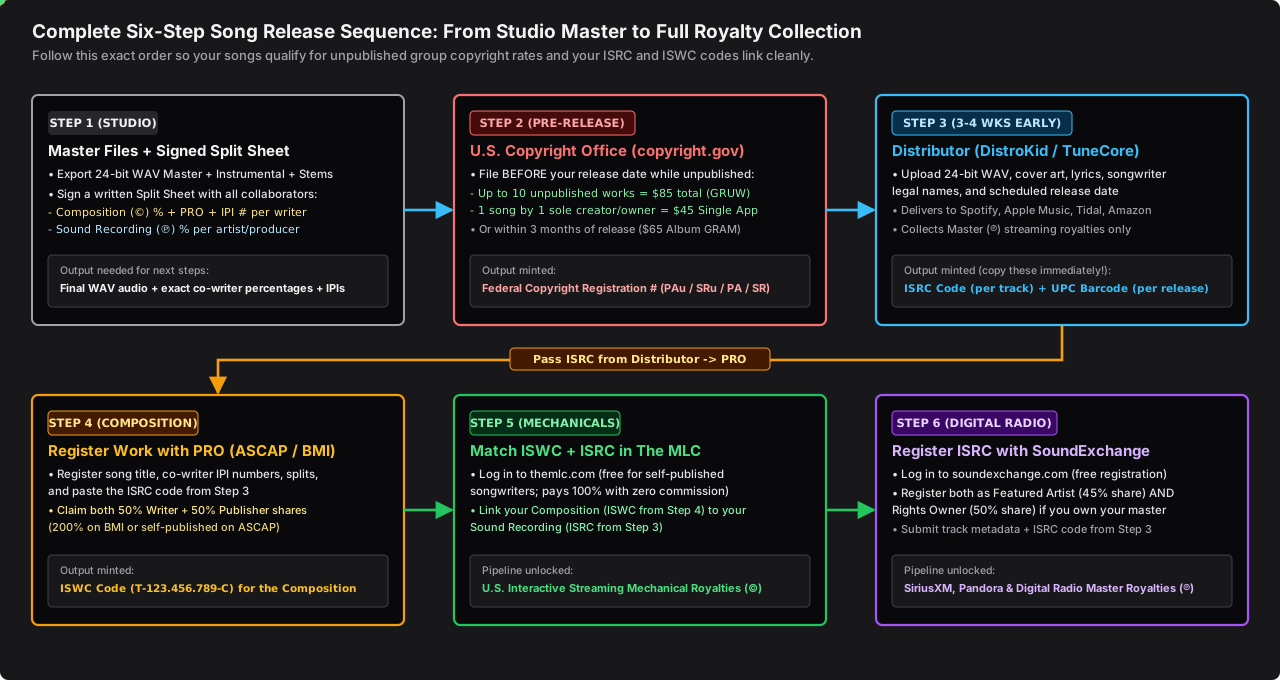
Following a fixed six-step release sequence closes every gap so all four royalty pipelines pay out from Day 1.
1. What a Digital Distributor (DistroKid, TuneCore, CD Baby) Does and Does Not Do
A Digital Distributor (also called a Digital Aggregator) is the delivery pipe between your hard drive and Digital Service Providers (DSPs such as Spotify, Apple Music, Tidal, Amazon Music, YouTube Music, TikTok, and Instagram/Meta Audio Library).
What Your Distributor Does:
- Delivers Audio and Metadata to DSPs: Ingests your
24-bit WAVmaster, album cover art (3000 x 3000 px), track titles, artist names, songwriter legal names, and release date. - Assigns Two Industry Codes (
ISRCandUPC):
- ISRC (International Standard Recording Code): Unique 12-character ID (
US-XXX-YY-NNNNN) assigned to each individual audio recording (℗). - UPC (Universal Product Code): Barcode number assigned to the overall single, EP, or album product.
- Collects Master Streaming and Download Royalties (
℗): Collects the ~50% to 55% Sound Recording (Master) share of interactive streaming revenue from Spotify, Apple Music, Tidal, and Amazon and deposits it into your distributor bank account (or splits it automatically among collaborators if you configure DistroKid Teams / TuneCore Splits).
What Your Distributor Does NOT Do:
- Does NOT Register Your Copyright with the U.S. Government: Uploading to DistroKid does not file a Form PA or Form SR with the Library of Congress (
copyright.gov). - Does NOT Collect Public Performance Royalties (
©): DistroKid cannot collect your ASCAP or BMI songwriter/publisher performance royalties. - Does NOT Collect Streaming Mechanical Royalties (
©): Unless you pay extra for a full publishing administration service, a basic DistroKid, TuneCore, or CD Baby distribution account does not collect your U.S. digital mechanical royalties from The MLC. - Does NOT Collect SiriusXM or Pandora Radio Master Royalties (
℗): Unless opted into a specific neighboring-rights add-on, statutory non-interactive digital radio royalties are collected directly through SoundExchange.
2. Gap #1: The MLC (Mechanical Licensing Collective - themlc.com)
Every time a listener streams your song on Spotify, Apple Music, Tidal, or Amazon Music in the United States, the stream triggers two separate Composition (©) royalties:
- A Public Performance Royalty (collected by ASCAP or BMI), and
- A Mechanical Royalty (for the on-demand digital reproduction/transmission of the musical work under
17 U.S.C. § 115).
Created by Congress under the Music Modernization Act of 2018 (MMA), The Mechanical Licensing Collective (The MLC) is the sole organization designated by the U.S. Copyright Office to administer the blanket mechanical license for interactive streaming services in the United States.
- Cost to Join: $0 (100% Free). By federal statute, streaming platforms (Spotify, Apple Music, etc.) are legally required to pay 100% of The MLC's operating costs, so The MLC deducts 0% commission and pays out 100% of your mechanical royalties.
- Who Should Join: Every self-administered songwriter (any songwriter who does not have a publishing administrator such as Songtrust, CD Baby Pro, TuneCore Publishing, or Sony/Universal Music Publishing already claiming their mechanicals).
- How to Claim Your Money in The MLC:
- Create a free Member account at
themlc.comas a Self-Administered Songwriter. - Enter your
IPI NumberandISWCcode from ASCAP or BMI. - Paste the ISRC code generated by DistroKid (or your distributor) to link your Sound Recording (
ISRC) to your Musical Composition (ISWC).
- Why this step is critical: Streaming services report usage to The MLC by ISRC, while songwriters register songs by title and ISWC. Until you link your
ISRCto yourISWCinside The MLC portal, your streaming mechanical royalties sit in The MLC's "Unmatched Royalties" pool!
- Create a free Member account at
3. Gap #2: SoundExchange (soundexchange.com)
While your distributor collects Master (℗) royalties from interactive streams (where the user picks the song, like Spotify or Apple Music), federal law (17 U.S.C. § 114) designates SoundExchange to collect statutory Master (℗) performance royalties from non-interactive digital radio (where the user cannot choose the exact next track on demand, such as SiriusXM Satellite Radio, Pandora Radio, iHeartRadio custom stations, and cable TV music channels like Music Choice).
By federal statute (17 U.S.C. § 114(g)(2)), SoundExchange splits every dollar it collects into three fixed buckets before paying out:
- 45% to the Featured Recording Artist(s): Paid directly to the featured performer(s) on the track.
- 50% to the Sound Recording Copyright Owner (Master Rights Owner): Paid to whoever owns the master (
℗), which is the record label or, for an independent artist, you. - 5% to Non-Featured Musicians and Vocalists: Paid through the AFM & SAG-AFTRA Intellectual Property Rights Distribution Fund to session musicians and background vocalists.
Important Rule when Registering at
soundexchange.com: If you are an independent artist who both performed on the track and owns your own master recording, you must select "Both" (Featured Artist and Rights Owner) during your free SoundExchange registration. If you register only as "Featured Artist," you will collect only 45% and leave your 50% Rights Owner share sitting uncollected (45% + 50% = 95% total goes to an independent self-releasing artist).
4. Complete Six-Step Checklist Before and After Every Release
| Step | Timing | Action | Codes Required / Minted |
|---|---|---|---|
| Step 1: Studio Master & Split Sheet | Immediately upon finishing the mix/master | Export 24-bit WAV master, instrumental, and stems. Have every songwriter and producer sign a Split Sheet recording legal names, emails, PRO (ASCAP/BMI), IPI numbers, Composition (©) split %, and Master (℗) split %. | Writers' IPI Numbers |
Step 2: U.S. Copyright Office (copyright.gov) | Before release date (or within 3 months of release) | File a Group of Unpublished Works ($85) for 2 to 10 unreleased songs, a Single Application ($45) for 1 sole-created song, or a GRAM Album Application ($65) for 2 to 20 tracks released on the same album on the same date. | Mints U.S. Copyright Registration Number (PAu/SRu/PA/SR) |
Step 3: Digital Distributor (DistroKid / TuneCore) | 3 to 4 weeks before release date | Upload the 24-bit WAV, artwork, lyrics, and release date. Once processed, copy the newly assigned ISRC code for each track and UPC for the release. | Mints ISRC (per track) and UPC (per release) |
Step 4: PRO Work Registration (ASCAP or BMI) | 1 to 2 weeks before release date | Log in to your ASCAP or BMI account. Register the composition title, co-writers' IPI numbers, Writer/Publisher splits (claim both shares if self-published), and paste the ISRC from Step 3. | Uses IPI + ISRC -> Mints ISWC (T-...) |
Step 5: The MLC (themlc.com) | Release week (once ISWC is issued) | Log in to your free MLC account. Verify that your composition appears under its ISWC and explicitly match/link the ISRC from Step 3 to that work. | Links ISWC (©) <-> ISRC (℗) |
Step 6: SoundExchange (soundexchange.com) | Release week | Log in to your free SoundExchange account (registered as both Featured Artist and Rights Owner) and submit the track metadata and ISRC from Step 3. | Registers ISRC (℗) for digital radio |
5. Interactive Release Checklist & Royalty Gap Simulator
Toggle each registration step below to see which royalty streams are collected and which sit unmatched when an artist stops at DistroKid or forgets to claim the Publisher's Share, The MLC, or SoundExchange:
royalty-checklist
Sources
- Music Modernization Act of 2018, Pub. L. No. 115-264,
17 U.S.C. § 115(d)(Blanket license for digital uses and Mechanical Licensing Collective). - The Mechanical Licensing Collective, How The MLC Works for Self-Administered Songwriters (
themlc.com/how-it-works). - SoundExchange, Statutory Royalty Distribution: Featured Artist (45%), Rights Owner (50%), Non-Featured Artists (5%),
17 U.S.C. § 114(g)(2)(soundexchange.com). - Donald S. Passman, All You Need to Know About the Music Business, 11th ed. (Simon & Schuster, 2023), Chapters 8, 13, and 14.