Performing Rights Organizations - ASCAP vs BMI and Writer vs Publisher Shares
A Performing Rights Organization (PRO) (in the United States, primarily ASCAP, the American Society of Composers, Authors and Publishers, and BMI, Broadcast Music, Inc., alongside invitation-only SESAC and GMR, Global Music Rights) licenses and collects public performance royalties for the Musical Composition (©).
Joining a PRO does not register your copyright with the U.S. Copyright Office (copyright.gov), does not distribute your audio files to Spotify, and does not collect mechanical royalties (The MLC) or master royalties (DistroKid / SoundExchange). Instead, your PRO acts as the global tracking and collection network whenever your composition is broadcast or performed in public.
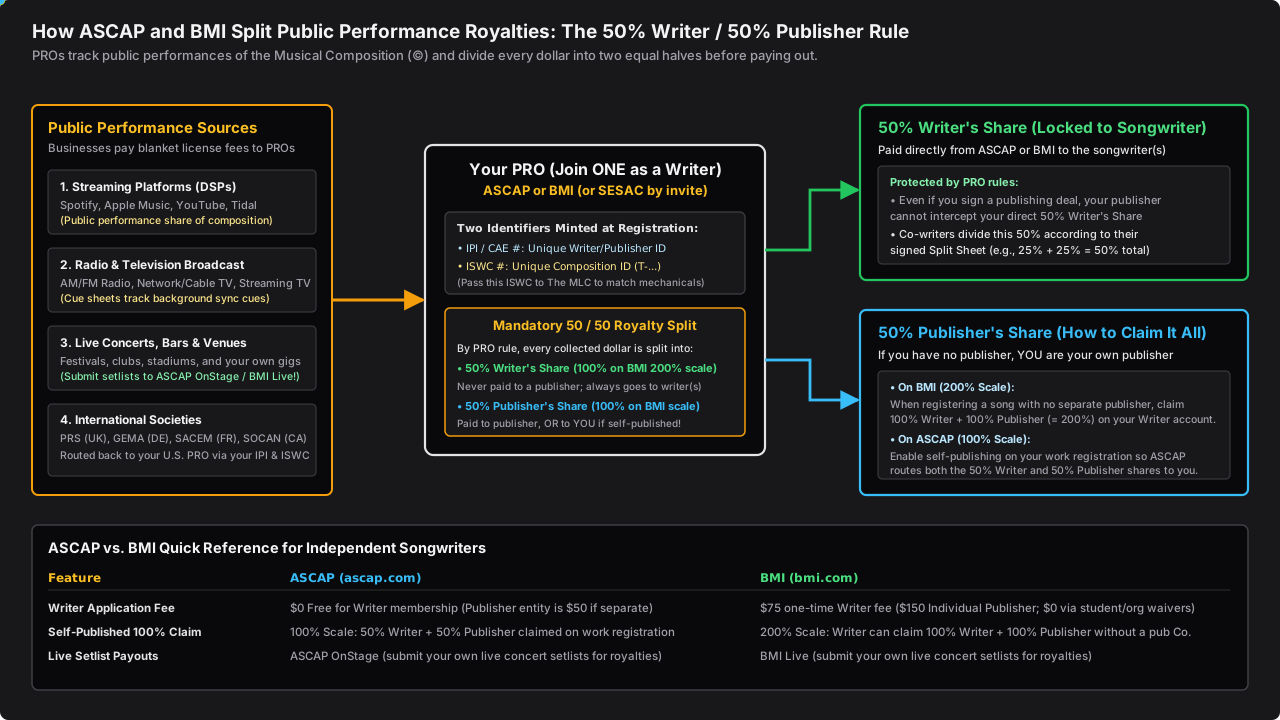
1. What Counts as a Public Performance?
Under 17 U.S.C. § 106(4), the owner of a musical composition holds the exclusive right to perform the copyrighted work publicly. Because millions of businesses play music every day, individual songwriters cannot negotiate directly with every radio station, bar, TV network, and streaming service. Instead, ASCAP and BMI issue blanket licenses to those businesses, collect the license fees, track which compositions were played, and distribute the royalties to registered songwriters and publishers.
Public performances tracked by ASCAP and BMI include:
- Interactive Streaming Platforms (DSPs): Spotify, Apple Music, YouTube, Amazon Music, and Tidal pay public performance license fees to PROs for every stream (separate from the mechanical royalty paid to The MLC and the master payout paid to your distributor).
- Terrestrial, Satellite, and Internet Radio: AM/FM broadcast stations, college radio, NPR, SiriusXM, and Pandora.
- Television and Streaming Video (Sync Cue Sheets): Network TV, cable TV, and streaming services (Netflix, Hulu, HBO/Max, Disney+, Prime Video). When your music is placed in a show or film, the production company submits a cue sheet listing the composition title, writer/publisher IPI numbers, duration, and usage type (theme, background, or visual vocal). Your PRO uses that cue sheet to pay backend broadcast and streaming performance royalties.
- Live Concerts, Festivals, Bars, and Venues: Concert halls, stadiums, clubs, restaurants, retail stores, and fitness studios pay annual blanket fees to PROs. Both ASCAP OnStage and BMI Live allow you to submit setlists from your own live performances of your original songs (even at small local bars and clubs) and receive quarterly live performance royalty payouts.
2. The Mandatory 50% Writer's Share / 50% Publisher's Share Split
By international PRO convention, ASCAP and BMI divide every dollar of public performance royalties into two equal, permanently separated buckets:
- The 50% Writer's Share: Paid directly by the PRO to the human songwriter(s) and composer(s) who wrote the song. Under PRO rules, a songwriter can never assign their Writer's Share to a publishing company; even if you sign a traditional publishing deal, ASCAP or BMI still sends the 50% Writer's Share directly to your personal bank account.
- The 50% Publisher's Share: Paid by the PRO to the music publisher(s) of the song to compensate for licensing, administration, and catalog promotion.
How an Independent Songwriter Collects the Full 100% (Both Shares)
If you are an independent songwriter who has not signed a publishing agreement with an outside publisher, you are your own publisher, meaning you are entitled to both the 50% Writer's Share and the 50% Publisher's Share (100% of the total performance royalty). However, ASCAP and BMI handle self-published claims differently:
- How BMI Handles Self-Publishing (The 200% Scale):
- BMI displays song splits on a 200% scale, where the Writer's Share totals
100%and the Publisher's Share totals100%(100% + 100% = 200%). - On BMI, you do not have to pay for a separate Publisher account if you are an independent songwriter with no outside publishing company. When you register a work in your BMI Writer portal and check that there is no publisher on the song, BMI allows you to claim both the
100%Writer Share and the100%Publisher Share (200%total) directly under your Writer account.
- BMI displays song splits on a 200% scale, where the Writer's Share totals
- How ASCAP Handles Self-Publishing (The 100% Scale):
- ASCAP displays song splits on a 100% scale, where the Writer's Share totals
50%and the Publisher's Share totals50%(50% + 50% = 100%). - ASCAP allows writers to register their works and claim both the
50%Writer Share and50%Publisher Share without forming a separate LLC, or to open a dedicated ASCAP Publisher membership ($50 one-time fee) if operating under a distinct publishing company name (DBA or LLC).
- ASCAP displays song splits on a 100% scale, where the Writer's Share totals
3. Two Global Codes Your PRO Generates: IPI and ISWC
When you join ASCAP or BMI and register your songs, the system generates two international identifiers that you must copy into your Split Sheets and into The MLC:
- IPI / CAE Number (Interested Parties Information): A unique 9-to-11 digit identification number assigned to you as a songwriter (and a second IPI number if you have a registered publishing entity). Every co-writer on a Split Sheet is identified by their full legal name, PRO affiliation (
ASCAPorBMI), and IPI Number so royalties never route to another songwriter with the same name. - ISWC (International Standard Musical Work Code): A unique identifier assigned to each registered composition (formatted
T-123.456.789-C). Once ASCAP or BMI generates your song'sISWC, copy thatISWCinto The MLC (themlc.com) alongside your distributor'sISRCcode so your mechanical and performance databases are linked.
4. ASCAP vs. BMI: Side-by-Side Comparison
You can only belong to one PRO at a time as a songwriter (though co-writers on the same song can belong to different PROs; for example, a 50% ASCAP writer and a 50% BMI writer can co-write a track without issue).
| Feature | ASCAP (ascap.com) | BMI (bmi.com) | SESAC (sesac.com) |
|---|---|---|---|
| Corporate Structure | Member-owned not-for-profit association run by a board of writers and publishers | For-profit corporation (transitioned from non-profit status in 2022) | Private, for-profit company |
| How to Join | Open to any songwriter/composer with at least 1 song written or ready for release | Open to any songwriter/composer | By invitation only |
| Writer Application Fee | $0 (Free) for Writer membership | $75 one-time application fee for Writer membership (often waived for college music students or via partner codes) | N/A (Invite only) |
| Publisher Entity Fee | $50 one-time fee if registering a separate publishing company name | $150 (Individual/Sole Proprietor Publisher) or $250 (LLC/Corporation), not required if claiming 200% on your Writer account | N/A |
| Split Entry Scale | 100% Scale (50% Writer + 50% Publisher = 100%) | 200% Scale (100% Writer + 100% Publisher = 200%) | 100% Scale |
| Claiming Publisher Share Without a Separate Publisher Account | Yes, via self-published work registration | Yes, by claiming 200% (100% Writer + 100% Publisher) on your Writer registration | Requires publisher registration |
| Live Gig Self-Reporting Program | ASCAP OnStage | BMI Live | SESAC Live Performance |
| Contract Term Length | 1-year auto-renewing agreement (can resign annually during your anniversary window) | 2-year agreement for writers | Varies by contract |
Sources
- ASCAP, How ASCAP Calculates and Pays Royalties and Join ASCAP FAQ (
ascap.com/help/royalties-and-payment). - BMI, What is the Difference Between a 100% and 200% Royalty Scale? and BMI Live Guidelines (
bmi.com/creators). - Donald S. Passman, All You Need to Know About the Music Business, 11th ed. (Simon & Schuster, 2023), Chapter 13 (Performing Rights Organizations).