The Two Copyrights in Every Song - Composition vs Sound Recording
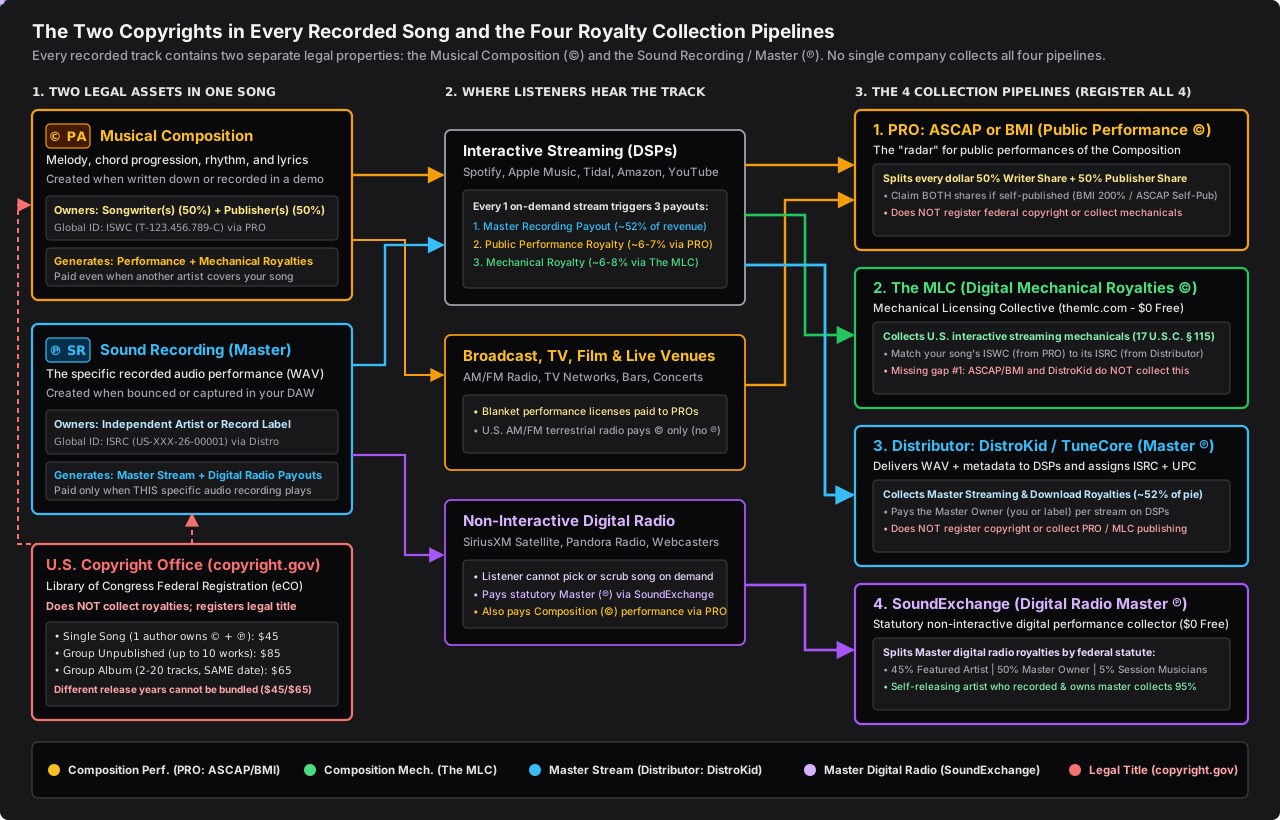
Under United States copyright law (17 U.S.C. § 102(a)(2) and § 102(a)(7)), every recorded song consists of two separate copyrightable works: the Musical Composition (©) and the Sound Recording (℗, commonly called the Master). Even when a solo producer writes, performs, mixes, and masters a song alone in one DAW session, the law treats the underlying song and the bounced audio file as two distinct assets that generate royalties through four separate collection pipelines.
1. The Musical Composition (© / Publishing)
The Musical Composition consists of the musical notes, melody, chord progression, rhythm, and any accompanying lyrics.
- Symbol and Copyright Office Class:
©(Form PA, Performing Arts). - Initial Owners: The songwriter(s), composer(s), and lyricist(s) who wrote the music and words. In standard music publishing, ownership of the composition is divided into a 50% Writer's Share and a 50% Publisher's Share. If you do not sign with a third-party music publishing company, you own both shares (100% of the composition) as a self-published songwriter.
- Global Identifier: ISWC (International Standard Musical Work Code), formatted as
T-123.456.789-C. Your Performing Rights Organization (ASCAP or BMI) assigns an ISWC when you register the composition. - When It Generates Money: The composition earns royalties every time the song is streamed, broadcast on radio or television, performed live in a licensed venue, pressed to vinyl/CD, licensed in a film or game (a synchronization license), or covered by another artist. If another singer records a new studio version of your song, you earn zero master royalties on their recording, but you earn 100% of the composition royalties from their streams and sales.
2. The Sound Recording (℗ / The Master)
The Sound Recording (the Master) is the specific fixation of sounds in an audio file (your final 24-bit WAV mix/master).
- Symbol and Copyright Office Class:
℗(the "P" in a circle stands for Phonogram, registered on Form SR, Sound Recording). - Initial Owners: The performing artist(s), producer(s), or the record label that funded and owns the master recording under a recording contract or work-made-for-hire agreement.
- Global Identifier: ISRC (International Standard Recording Code), a 12-character alphanumeric code formatted as
CC-XXX-YY-NNNNN(for example,US-S1Z-26-00001). Your digital distributor (DistroKid, TuneCore, or CD Baby) assigns a unique ISRC to every audio track you upload. If you release a Radio Edit, an Instrumental, and a Live Version of the same song, all three share one ISWC (one composition) but receive three different ISRCs (three separate sound recordings). - When It Generates Money: The sound recording earns royalties when that exact audio file is streamed on Spotify or Apple Music, downloaded on iTunes or Bandcamp, played on satellite or internet radio (SiriusXM, Pandora), or licensed into a film, TV show, or commercial (a master use license).
3. How One Interactive Stream Splits Across Three Organizations
When a listener plays your song on an interactive, on-demand streaming service (Spotify, Apple Music, Tidal, Amazon Music), the platform does not pay one single check. Out of every $1.00 of gross streaming revenue collected by the platform:
- Platform Retention (~30%): The streaming service retains roughly 30% to cover platform operations.
- Sound Recording / Master Payout (~52% to 55%): Paid by the streaming platform to your Digital Distributor (
DistroKid,TuneCore,CD Baby) or record label, which then pays the Master Owner(s). - Musical Composition Public Performance Royalty (~6% to 7%): Paid by the streaming platform to Performing Rights Organizations (
ASCAP,BMI,SESAC), which split the payment 50/50 between the songwriter(s) and publisher(s). - Musical Composition Mechanical Royalty (~6% to 8%): Paid by the streaming platform under the
17 U.S.C. § 115blanket statutory license to The Mechanical Licensing Collective (The MLC), which pays 100% of the mechanical royalty to the publisher (or self-published songwriter).
4. Why Terrestrial Radio and Digital Radio Pay Differently in the United States
In the United States, broadcast and digital radio follow a dual statutory rule under 17 U.S.C. § 114:
- AM/FM Terrestrial Radio (Over-the-Air Broadcast): Pays Composition (
©) public performance royalties through ASCAP, BMI, and SESAC, but is exempt under federal law from paying Sound Recording (℗) royalties to the performing artist or label. - Non-Interactive Digital Radio (SiriusXM Satellite Radio, Pandora Free/Radio Tier, iHeartRadio Non-Interactive Webcasting, Music Choice): Because the listener cannot choose or scrub a specific song on demand, federal law (
17 U.S.C. § 114(d)(2)) requires these services to pay a statutory Sound Recording (℗) digital performance royalty through SoundExchange, in addition to paying the Composition (©) performance royalty through ASCAP and BMI.
Summary Comparison: Composition (©) vs. Sound Recording (℗)
| Attribute | Musical Composition (©) | Sound Recording / Master (℗) |
|---|---|---|
| Legal Symbol | © (Copyright) | ℗ (Phonogram / Sound Recording) |
| What Is Protected | Melody, harmony/chords, rhythm, lyrics | Specific recorded audio performance (WAV master) |
| U.S. Copyright Office Form | Form PA (Performing Arts) | Form SR (Sound Recording) |
| Standard Tracking Code | ISWC (T-123.456.789-C), issued by PRO | ISRC (US-XXX-26-00001), issued by Distributor |
| Primary Owners | Songwriters (50% Writer Share) + Publishers (50% Publisher Share) | Recording Artist / Independent Master Owner or Record Label |
| On-Demand Streaming Collector | ASCAP / BMI (Performance) + The MLC (Mechanical) | Distributor (DistroKid, TuneCore, CD Baby) |
| Digital Radio (SiriusXM / Pandora) Collector | ASCAP / BMI | SoundExchange (45% Artist, 50% Master Owner, 5% Session Players) |
| Film / TV Placement License Required | Synchronization ("Sync") License (from Publisher) | Master Use License (from Master Owner / Label) |
Sources
17 U.S.C. § 102(a)(2)(Musical works, including any accompanying words) and17 U.S.C. § 102(a)(7)(Sound recordings).- U.S. Copyright Office, Circular 56A: Copyright Registration of Musical Compositions and Sound Recordings (
copyright.gov/circs/circ56a.pdf). - Donald S. Passman, All You Need to Know About the Music Business, 11th ed. (Simon & Schuster, 2023), Chapters 6, 12, and 15.