US Copyright Office Registration - Single vs Album and Group Rules
Under 17 U.S.C. § 102, copyright protection attaches automatically the moment your song is fixed in a tangible medium (such as a WAV file on your hard drive or a score). However, neither DistroKid nor ASCAP/BMI registers your song with the federal government. Formal registration with the U.S. Copyright Office (copyright.gov, part of the Library of Congress) is a separate federal filing with strict rules governing when multiple songs can be bundled under a single fee and when each song must be paid for individually.
1. "Fixed" Copyright vs. Federal Registration (17 U.S.C. § 102 vs. §§ 410-412)
In everyday conversation, musicians often use the word "copyrighted" to mean two different legal states: automatic copyright upon fixation and federal copyright registration with the U.S. Congress (the U.S. Copyright Office at the Library of Congress).
| Legal State | How It Happens | What Proof You Have | Legal & Financial Limits in a Dispute |
|---|---|---|---|
1. Automatic Copyright ("Fixed in a Tangible Medium")17 U.S.C. § 102(a) | Attaches automatically for $0 the moment your song is saved to any physical or digital medium (an MP3 or WAV on a computer hard drive, USB drive, CD, voice memo, DAW session, or written chord chart). | Your own local files, DAW timestamps, lyric notebooks, drafts, or emails. | - Cannot sue in federal court: You are legally barred from filing an infringement lawsuit until the U.S. Copyright Office registers the work (17 U.S.C. § 411(a)).- No presumption of validity: In a dispute over who wrote the song first, you carry the burden of proving authorship and chain of evidence. - No statutory damages or attorney's fees if infringement starts before registration ( 17 U.S.C. § 412). |
2. Registered Copyright (U.S. Copyright Office / Library of Congress)17 U.S.C. §§ 408-412 | Filed online through eCO (copyright.gov) with a federal filing fee ($45 to $85) and a deposit copy (WAV or MP3 upload). | Official U.S. Copyright Office Certificate of Registration (PA, SR, PAu, or SRu) listed in the public Library of Congress catalog. | - Unlocks federal court enforcement (§ 411(a)).- Prima Facie Evidence ( § 410(c)): If registered before or within 5 years of first publication, the court legally presumes your copyright is valid and the certificate facts are true.- Statutory Damages ($750 to $150,000 per work) + Attorney's Fees ( §§ 412, 504(c)) if registered before infringement or within 3 months of release. |
Registering your work through the Electronic Copyright Office (eCO at copyright.gov) provides three specific legal protections that an unregistered MP3 on a hard drive does not give you:
- Prerequisite to File an Infringement Lawsuit (
17 U.S.C. § 411(a)): Under the Supreme Court's ruling in Fourth Estate Public Benefit Corp. v. Wall-Street.com, LLC (2019), you cannot file a copyright infringement lawsuit in a U.S. federal court until the U.S. Copyright Office has issued a registration certificate for your work. - Statutory Damages and Attorney's Fees (
17 U.S.C. §§ 412and504(c)): If you register your song before an infringement begins, or within 3 months of its first publication date, you can sue for statutory damages (between $750 and $30,000 per infringed work, and up to $150,000 per work for willful infringement) plus recovery of your attorney's fees, without having to prove the infringer's exact financial profits. If you wait until after an infringement occurs (and more than 3 months after release) to register, you are limited to actual proven damages and must pay your own legal fees, which makes most lawsuits financially impossible to bring. - Prima Facie Evidence of Validity (
17 U.S.C. § 410(c)): A registration filed before or within 5 years of first publication constitutes prima facie (presumed valid) evidence in court that you own the copyright and that the facts stated on the certificate are true. Instead of relying solely on diaries or hard drive dates that can be contested in court, the federal registration shifts the burden of proof onto the opposing party.
2. 2026 U.S. Copyright Office Online Filing Fees (Circular 4)
The U.S. Copyright Office offers four primary online application options for musicians. Filing online via eCO is substantially cheaper and faster than paper forms:
| Application Type | 2026 Online Fee | Max Works per Filing | Exact Eligibility Requirements |
|---|---|---|---|
| Single Application | $45 | 1 song (can cover both the Musical Composition © and Sound Recording ℗ in one filing) | All 4 must be true: 1. Exactly one work (one song, not a collection) 2. Written and performed by one sole individual 3. That same individual is the sole owner/claimant of both © and ℗4. Not a work made for hire |
| Standard Application | $65 | 1 song (can cover both © and ℗ only if the exact same co-authors own both) | Used for any single song that does not qualify for the $45 Single Application (for example, 2 or more co-writers, a guest vocalist, a separate producer, an LLC/label claimant, or a work made for hire). If the writers of the composition (©) differ from the owners of the master (℗), you must file a separate $65 Form PA and $65 Form SR. |
Group of Unpublished Works (GRUW) (Circular 55) | $85 | 2 to 10 unpublished works (up to 10 songs if registering ℗+© together under the same sole/joint authors) | All 4 must be true (37 C.F.R. § 202.4(c)):1. Every work in the group must be unpublished (not yet on Spotify, Apple Music, YouTube, or Bandcamp) on the day you submit the application 2. All works must have the same author or exact same co-authors 3. The copyright claimant(s) must be the same for every work 4. You must register all works in the same administrative class (registering the Sound Recording also covers the underlying Musical Composition if the claimant owns both) |
Group of Works on an Album of Music (GRAM) (Circular 58) | $65 | 2 to 20 published works on the same album | All 4 must be true (37 C.F.R. § 202.4(k)):1. Every work in the group must have been first published on the SAME album on the SAME date (and therefore in the same calendar year) 2. All works must have the same copyright claimant 3. Sound recordings ( ℗) and musical compositions (©) require two separate $65 GRAM applications ($130 total for up to 20 album tracks) |
3. Why You Cannot Bundle Published Songs from Different Years Into One Group Application
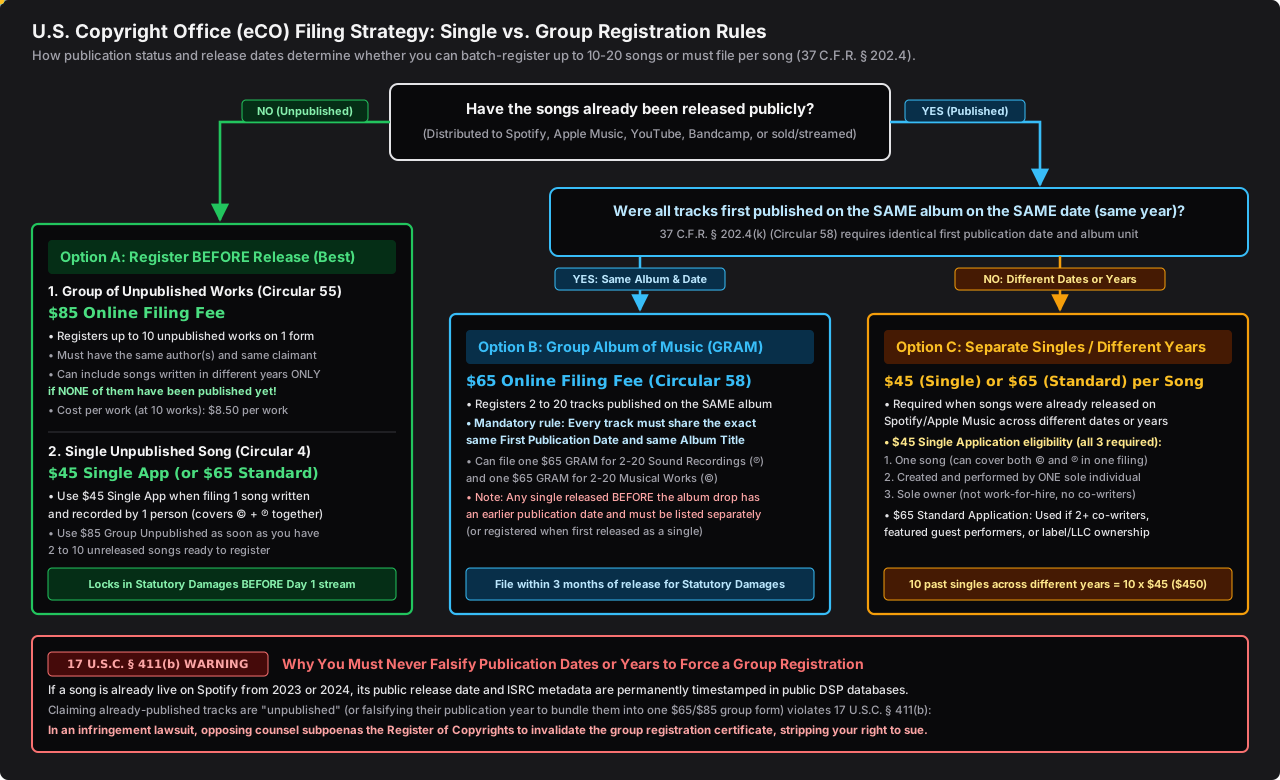
A common point of confusion occurs when an independent artist has released 10 singles on Spotify across different dates or different calendar years (for example, 3 singles in 2023, 4 singles in 2024, and 3 singles in 2025) and wants to register all 10 together for one single group fee. Under federal copyright regulations (37 C.F.R. § 202.4), previously published singles from different release dates or different years cannot be combined into one group application:
- Disqualified from Group of Unpublished Works (
$85): The moment DistroKid delivers your single to Spotify, Apple Music, or iTunes and the release goes live to the public for streaming or download, the work is legally published (17 U.S.C. § 101; U.S. Copyright Office Compendium § 1902). Once published, a track can never be registered on an Unpublished application. - Disqualified from Group of Works on an Album of Music (
$65GRAM): Under37 C.F.R. § 202.4(k)(1)(v)(Circular 58), every track on a GRAM application must have been first published on the same album on the exact same date. The eCO GRAM form has only a single "Date of First Publication" field for the entire album unit.
- If you released 10 standalone singles on different dates (or across different years), each single has its own distinct Date of First Publication.
- Even if you later compile those 10 previously released singles onto a compilation album in 2026, any track that was previously published as a standalone single in a prior year cannot share the compilation's first-publication date on a GRAM filing unless it was first published within the same calendar year and explicitly noted under Circular 58's previously published single rules. Tracks first published in different calendar years are strictly barred by the eCO system from being grouped into a single GRAM application.
What Happens If You Enter a False Creation or Publication Year? (17 U.S.C. § 411(b))
Do not enter a false Date of First Publication or pretend that already-released Spotify tracks from 2023 and 2024 are "unpublished" just to squeeze 10 songs onto one $65 or $85 group form:
- Your actual release dates,
ISRCcodes, and Distributor delivery dates are permanently logged in public DSP databases (Spotify, Apple Music, MusicBrainz, Luminate, and The MLC). - Under
17 U.S.C. § 411(b)(and the Supreme Court's analysis in Unicolors, Inc. v. H&M Hennes & Mauritz, L.P., 2022), if you sue an infringer and the defense proves that you knowingly included inaccurate publication dates or status on your application, the federal court is required by statute to ask the Register of Copyrights whether the Copyright Office would have refused the group registration had it known the tracks were published in different years. - Because the Copyright Office strictly refuses group registrations for works published in different calendar years, the Register advises the court that registration would have been refused, which invalidates your registration certificate and gets your infringement lawsuit dismissed.
4. Optimal Filing Strategy by Release Scenario
| Your Scenario | Best Legal & Financial Strategy | Total U.S. Copyright Office Cost |
|---|---|---|
| Scenario 1: You have 2 to 10 finished, UNRELEASED songs (even if written across different years, e.g., 2024 to 2026, as long as none have been released publicly yet) | File a Group of Unpublished Works (GRUW) at copyright.gov BEFORE uploading to DistroKid or releasing on Spotify. Because unpublished registration only checks creation, songs written in different years can be grouped together if they have never been published! | $85 total for up to 10 songs ($8.50 per song) |
| Scenario 2: You are releasing 1 standalone single (written and recorded 100% by you alone) | File a Single Application either before release or within 3 months of release, checking both Sound Recording and Musical Work on the single form. | $45 (covers both © and ℗ in one filing) |
| Scenario 3: You are releasing a 10-track album all on the same day (none of the tracks were released earlier in a prior year) | Option A (Cheapest): Register all 10 tracks before release date as a Group of Unpublished Works. Option B (Post-release): Within 3 months of the album drop, file GRAM ($65 for up to 20 Sound Recordings ℗ + $65 for up to 20 Musical Works ©). | Option A: $85 Option B: $130 ($65 ℗ + $65 ©) |
| Scenario 4: Back-catalog of 10 singles already on Spotify across different years (2022, 2023, 2024, 2025) | File individual Single Applications ($45) (if sole writer/performer/owner) or Standard Applications ($65) (if co-written) for each single, using its true historical Spotify release date. If 2 or more singles were released together as an EP on the exact same date in the same year, group those same-date tracks under a $65 GRAM filing. | $45 per sole-author single ($450 for 10 separate singles across different years) |
5. Interactive U.S. Copyright Office Fee & Filing Strategy Calculator
Use the calculator below to model your release catalog (number of songs, unpublished vs. same-day album vs. multi-year singles, and sole author vs. co-writers) and compare the exact U.S. Copyright Office filing cost before release versus after release:
copyright-calculator
Sources
17 U.S.C. §§ 409, 410(c), 411(a)-(b), 412, 504(c)and37 C.F.R. § 202.4(c)(Group registration of unpublished works) and§ 202.4(k)(Group registration of works on an album of music).- U.S. Copyright Office, Circular 4: Copyright Office Fees (2026), Circular 55: Copyright Registration for Unpublished Works, and Circular 58: Copyright Registration for Works on an Album of Music (
copyright.gov/circs/). - Fourth Estate Public Benefit Corp. v. Wall-Street.com, LLC, 586 U.S. 296 (2019); Unicolors, Inc. v. H&M Hennes & Mauritz, L.P., 595 U.S. 178 (2022).