Woodwind Registers
Woodwind Registers
Unlike strings (where the register changes timbre subtly), woodwinds have dramatically different registers because of how the overtone series breaks across keys and tone-holes. Choose your register first, then write the line.
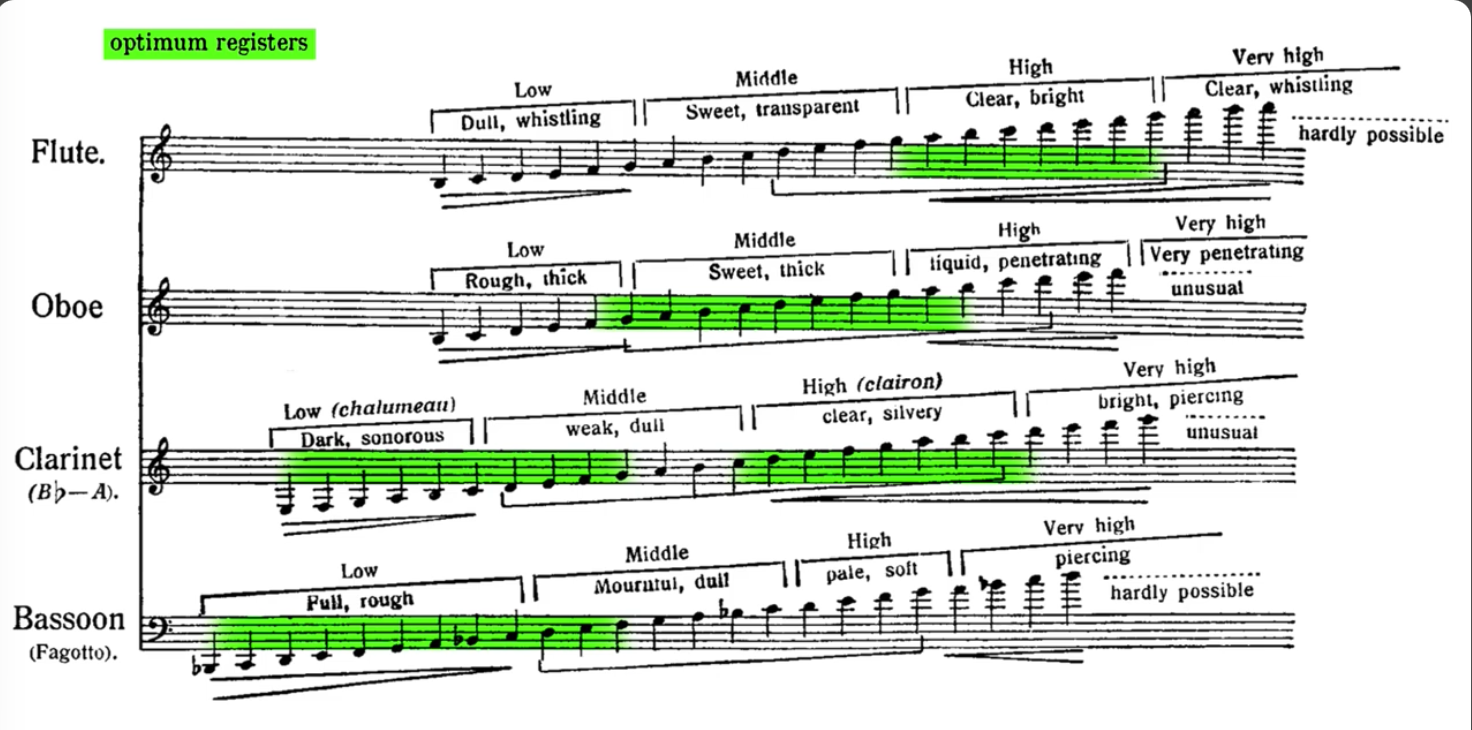
Flute
| Register | Character | Notes |
|---|---|---|
| Low (c¹–c²) | Warm, breathy, easily covered by other instruments | Beautiful but vulnerable. Don't write a low flute solo against full strings. |
| Middle (c²–c³) | Singing, balanced, the default solo register | The "voice" of the flute. Most concerto melodies live here. |
| High (c³–c⁴) | Brilliant, piercing, cuts through anything | Use sparingly for brilliance and climax. |
| Altissimo (above c⁴) | Strained, screaming | Modernist territory. |
Clarinet
The clarinet has the most dramatic register changes of any wind:
| Register | Character | Notes |
|---|---|---|
| Chalumeau (e–f¹ written) | Dark, woody, mysterious | The envy of every other instrument. The clarinet sound. |
| Throat tones (f#¹–bb¹ written) | Weak, slightly nasal | Avoid sustained writing here. Pass through quickly. |
| Clarion (b¹–c³ written) | Clear, brilliant, projecting | The standard solo register. |
| Altissimo (above c³ written) | Screaming, expert only | Modernist or jazz. Don't write this for students. |
Watch the register break around written Bb4–B4 — that's the seam between throat tones and clarion. Crossing it is awkward; sitting on it is painful.
Oboe
| Register | Character | Notes |
|---|---|---|
| Low (bb–e¹) | Thick, reedy, hard to play soft | Heavy and grounded but loud. |
| Middle (e¹–e³) | The iconic singing voice | This is what oboe means to most listeners. |
| High (e³–a³) | Pinched, strained | Use only for character moments. |
The oboe's middle register tunes the orchestra because it's the hardest to mask. Think of the Swan from Carnival of the Animals or the Shostakovich Second Symphony opening.
Bassoon
| Register | Character | Notes |
|---|---|---|
| Low (Bb1–F2) | Growling, comic OR sinister | Sorcerer's Apprentice low writing. |
| Tenor (F2–F3) | Singing, almost cello-like — one of the most expressive solo voices | Stravinsky's Rite of Spring opening lives here. |
| High (F3–eb²) | Vulnerable, exposed | The famous high bassoon sound. |
Don't write the bassoon as a tuba. Its tenor register is one of the most expressive solo voices in the entire ensemble.
Saxophone
The saxophone family (sop/alto/tenor/bari) is unusual: every member has the same fingerings and roughly the same register character because they all share the same conical-bore single-reed design. The differences are mostly register (where each lives in absolute pitch), not character.
| Sax | Register notes |
|---|---|
| Soprano | Notoriously hard to play in tune. The Coltrane My Favorite Things sound. |
| Alto | Schoolroom standard. Charlie Parker's voice. |
| Tenor | The emotional center. Coltrane, Rollins, Getz. |
| Baritone | The bass, the funk anchor. Mulligan's cool jazz lead. |
See also: Woodwind Techniques, Transposition for Woodwinds, Single Tonguing